

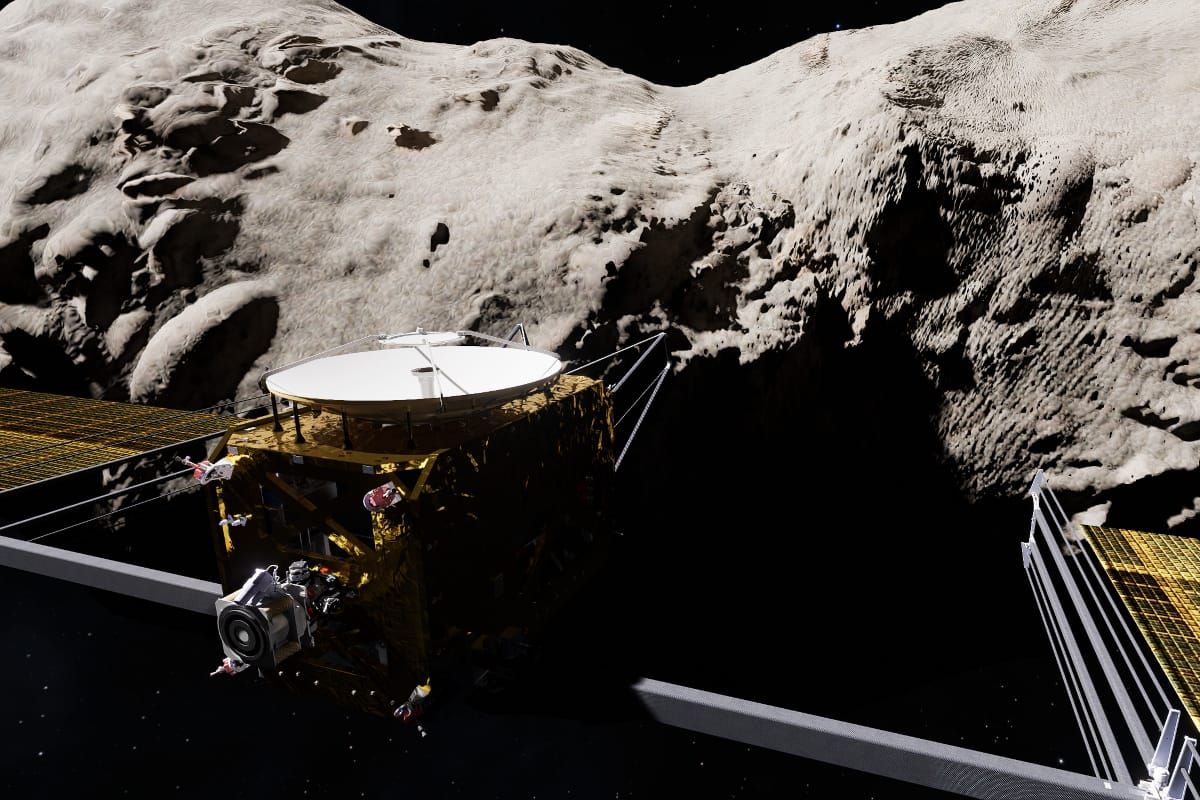
We build spacecraft to go to asteroids, extract and return material to Earth orbit.
Two vehicles drive our roadmap. The first proves the approach and starts delivering water. The second is ten times its size and goes after entire asteroids.
The fleet
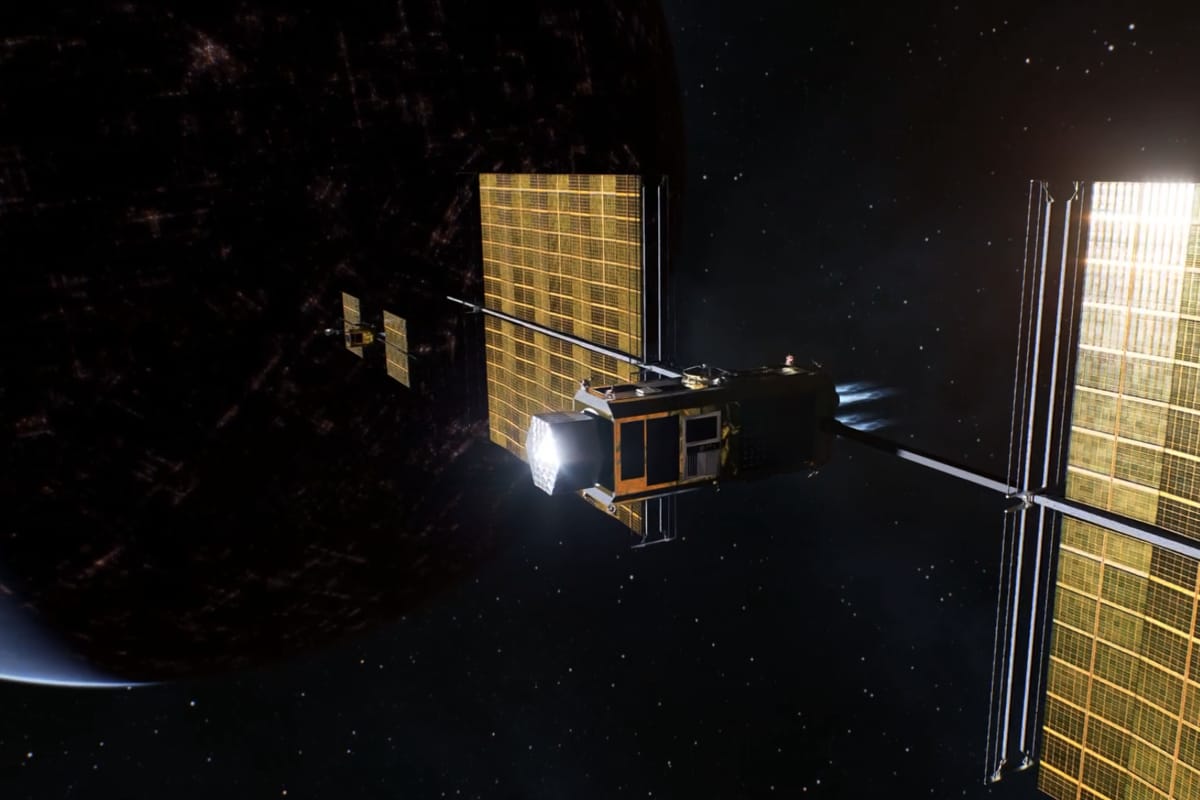
The ratio is deliberate. Roc is ten times Corvus in both mass and power, which means the same power-to-mass architecture scales across a factor of ten rather than being redesigned for it. What we learn flying Corvus is what we fly on Roc.
We leverage the efficiency of electric propulsion systems to move mass around outside of Earth's gravity well.
Mission 1 — 99942 Apophis
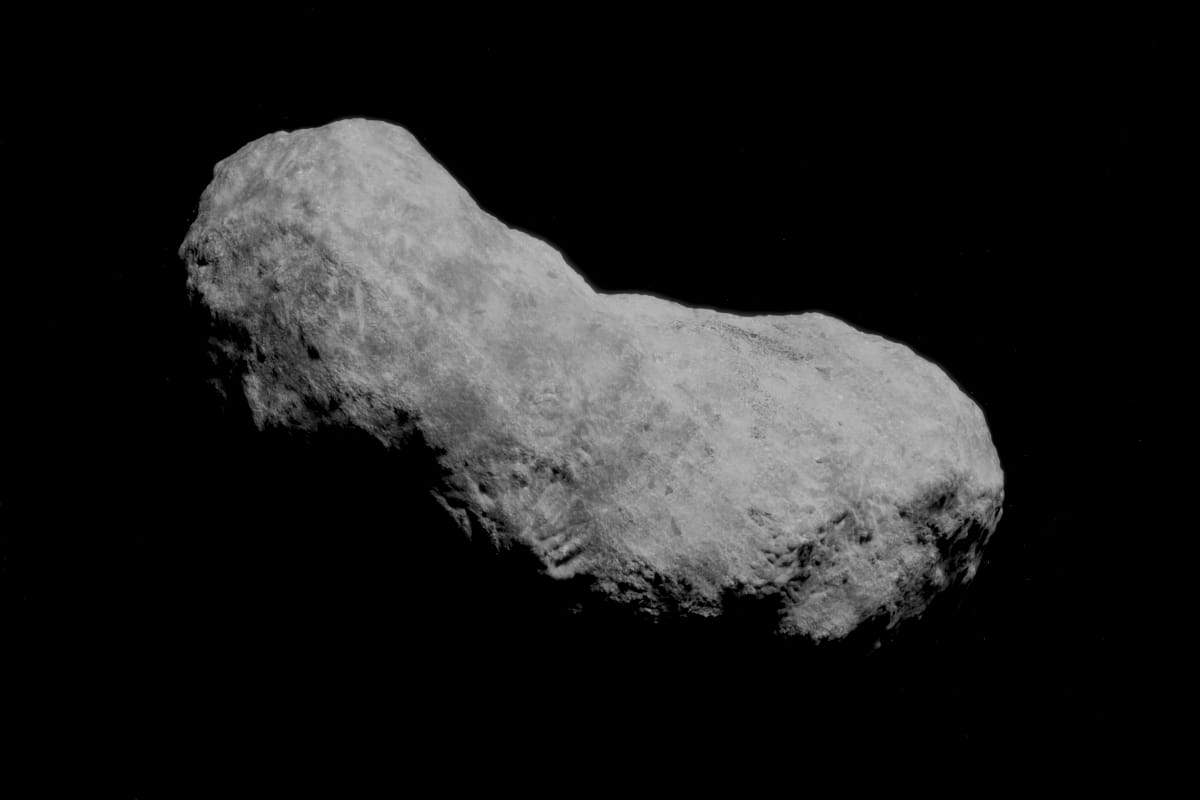
Corvus · Launch mid-2028 · Rendezvous 2030 · Building & Testing
Our first spacecraft is going to asteroid Apophis.
The target
Apophis is a ~340 metre near-Earth asteroid that passes within about 32,000 km of Earth's surface on 13 April 2029, closer than the geostationary satellites. A body that size coming that close is rare. It has been studied more thoroughly than almost any other asteroid, and that study definitively ruled out any impact risk, for this approach and the ones after it.
It is an S-type: a dry ball of dirt. We would rather have a C-type rubble pile full of water, but that is not available here... But this mission is a technology demo and Apophis offers a lot of benefits.
Why we picked it
Our approach to mission design is built around staying flexible. Targets get re-ranked whenever anything changes: the launch slot, the vehicle, the market. When our launch moved to mid-2028 we re-ran our leaderboard and Apophis came out on top, because its close approach lands almost exactly when we reach Earth escape.
That timing drives the opportunity. It puts us at the most observed asteroid in history, at the moment it is being observed, doing something nobody else there is doing.
What we will do
Rendezvous with Apophis, then deploy our tests to the surface. It is a full end-to-end rehearsal of what a mining spacecraft has to get right: autonomous deep space navigation, proximity operations around a small irregular body, and contact with a surface whose properties we will not know precisely until we arrive.
Everything we learn calibrates the models behind every mission after it. That is worth more to us than the destination.
We will have company
Apophis 2029 is drawing a small fleet, and it will be the first small body ever to have multiple spacecraft around it at once.
OSIRIS-APEX (NASA) — the OSIRIS-REx spacecraft, repurposed after returning its Bennu sample. It rendezvouses shortly after the close approach and follows Apophis for around 18 months.
RAMSES (ESA/JAXA) — a mothership with deployable cubesats carrying spectrometers, seismometers, and laser and optical imaging. It arrives roughly two months ahead of the close approach for about six months of observation.
Their data makes ours better and ours adds something to theirs. And we are putting hardware on the surface.
Read the full mission announcement →
Water delivery
Corvus · Three missions, 2029 and 2030 · In design
This is the point of everything before it.
Three Corvus missions across 2029 and 2030 go to water-bearing asteroids, extract and process regolith and deliver propellant-grade water customers in (GEO) Earth orbit. Water is fuel. Fuel delivered in orbit is what extends the life of satellites already up there and what makes the next thing launched cheaper than the last, because it no longer has to carry everything it will ever need.
These are the first missions with customers on the other end, and the first time asteroid material does commercial work rather than sitting in a curation facility.
Full asteroid return
Roc · First mission 2031 · In development
Roc is the step change: 7,000 kg and 100 kW, built to explore returning an entire asteroid rather than material extracted from one.
Moving a whole body rather than processing it in place changes the economics and it changes what is possible downstream, because everything that arrives is available at once instead of a delivery at a time. It is a harder problem in every dimension — capture, structural loads, trajectory, and what you do with several hundred tonnes of asteroid once it is where you want it.
First mission in 2031.
Roadmap
Each step is set out in our Master Plan: reach asteroids cheaply and autonomously, mine them in zero gravity, process what we extract in place. Water first, because water is fuel and fuel is what makes everything after it possible.